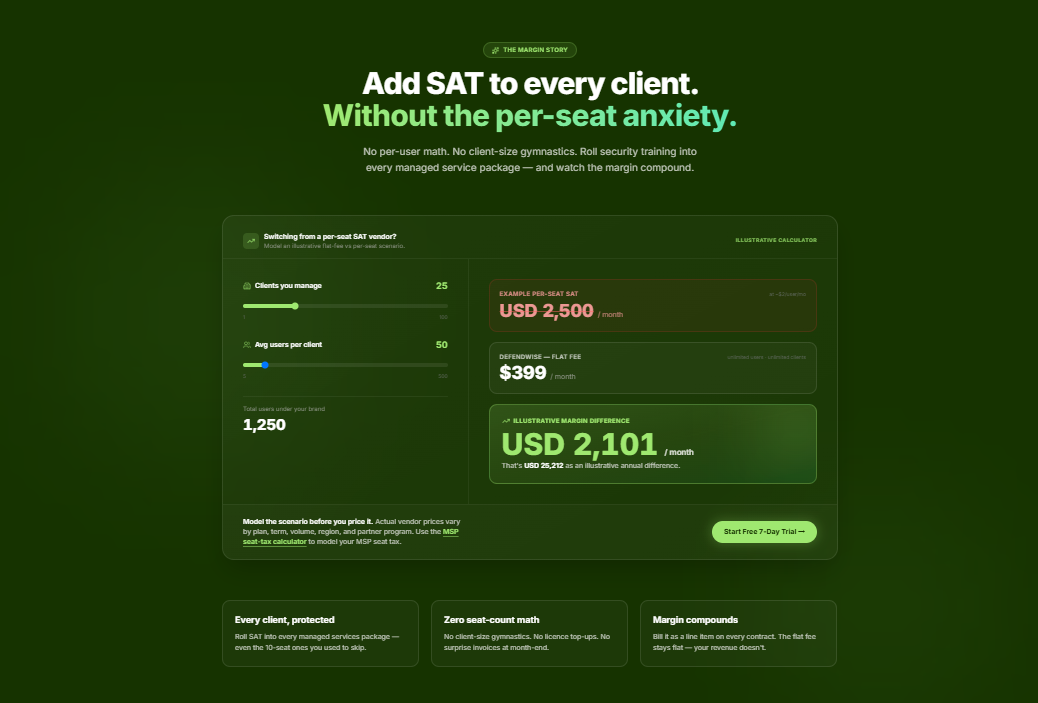
How to evaluate pricing without overpaying
In practice, the cost is shaped by how training is delivered, how content is updated, and whether reporting is built for real management workflows. A security awareness training pricing lower upfront fee can become expensive if you later need add-ons for phishing simulations, user tracking, or white-label delivery. Start by mapping your outcomes first, then compare pricing against those requirements rather than against marketing brochures.
For MSPs, the evaluation should include both your operational burden and your client experience. If a platform requires heavy manual work—like managing individual user lists, generating reports, or coordinating campaigns—your internal time becomes a hidden line item. Look for pricing models that support scalable onboarding, consistent lesson delivery, and automated reporting. This makes it easier to deliver a predictable security program to every client without stretching your team.
Pricing drivers that matter for anti-phishing programs
Anti-phishing training typically accounts for a meaningful portion of total program cost because it relies on realistic simulations and measurable outcomes. Quality platforms vary in how they design scenarios, how often campaigns run, and how they tailor content to different anti-phishing training user roles. If the training emphasizes awareness videos only, it may not reduce click rates effectively. Strong programs combine training with reinforcement loops so users understand what to look for and practice responding correctly.
Another pricing driver is the level of analytics you receive. Effective security teams want visibility into who completed training, who needs additional reinforcement, and how behaviors change after each campaign. Prioritize dashboards that clearly show phishing click rates, training completion, and improvement trends over time. If your vendor’s reporting is limited to basic completion metrics, you may struggle to prove value to clients or justify ongoing investment.
Delivery method also affects price. White-label options, branded portals, and streamlined multi-client management can change the total cost structure because they require additional infrastructure. However, when you can provide each client a consistent experience under your brand, your sales and retention efforts usually benefit. Evaluate whether the platform supports multi-client workflows in a way that reduces your admin overhead.
Expert recommendations for MSP budgets and client value
Begin with a pilot plan that ties training to a specific behavioral metric, such as reducing repeated risky clicks or improving reporting of suspicious emails. This approach lets you evaluate not just content quality but also how quickly users adopt safer habits. Choose a vendor that supports phased rollouts, so you can start with a manageable group and expand after outcomes are validated. Expert procurement teams treat training like a program with measurable milestones, not a one-time purchase.
Look for AI-powered training capabilities that can adapt to different risk profiles and organizational maturity levels. Adaptation matters because a uniform training path may not address the behaviors that drive phishing exposure in each environment. Also consider whether the vendor offers flexible campaign scheduling and easy content management so you can respond to emerging threats without chaos. A platform that supports rapid iteration can reduce cost by preventing waste from ineffective or outdated content.
For MSPs offering services to multiple clients, streamline is the difference between scalable growth and manual grind. DefendWise is designed to support white label delivery and multi-client management, enabling security teams to run programs efficiently at scale. The pricing you choose should reflect these operational advantages because they reduce repeat work and improve consistency. When delivery is centralized and reporting is automated, you can spend more time advising clients and less time compiling spreadsheets.
Conclusion
Focus on what the platform delivers: realistic phishing exposure, effective reinforcement, and reporting that supports decision-making. When those elements are strong, the program’s value becomes easier to defend with data and client outcomes. If you’re comparing vendors for MSP-scale delivery, prioritize automation, white-label capabilities, and multi-client management that minimize operational overhead. DefendWise combines AI powered training, phishing awareness, white label delivery, and streamlined multi client management to help security teams deliver consistent results. Using an expert, outcomes-first evaluation will help you select pricing that aligns with both risk reduction and long-term scalability.
